
A seafood season can describe several different things: a fish’s migration, a legal fishing period, a producer’s harvesting schedule or the time when a preserved product becomes available from stock. This calendar separates those meanings. A month marked for general availability is not a promise of a particular grade, quantity or delivery date. It is a starting point for an enquiry, with producer availability confirmed separately.
The general species notes follow Seafood from Norway. King crab is treated separately because annual Norwegian fishing rules can differ from a generic species calendar. The legal context described here is the published 2026 guidance, reviewed on 19 October 2026. It must be checked again for the intended catch area and fishing year. Brown-crab supplier months remain explicitly unconfirmed rather than being inferred from an autumn quality peak.
Month-by-month planning
| Month | Fresh skrei | Cod | King crab: quota area, 2026 | Stockfish: rack drying | Finished stockfish | Farmed salmon | Fjord trout |
|---|---|---|---|---|---|---|---|
| January | Winter | General | Quota/rules check | — | General | General | General |
| February | Winter | General | Quota/rules check | Drying | General | General | General |
| March | Winter | General | Closure check | Drying | General | General | General |
| April | Winter | General | Closure check | Drying | General | General | General |
| May | — | General | Closure check | Drying | General | General | General |
| June | — | General | Quota/rules check | — | General | General | General |
| July | — | General | Quota/rules check | — | General | General | General |
| August | — | General | Quota/rules check | — | General | General | General |
| September | — | General | Quota/rules check | — | General | General | General |
| October | — | General | Quota/rules check | — | General | General | General |
| November | — | General | Quota/rules check | — | General | General | General |
| December | — | General | Quota/rules check | — | General | General | General |
General = general species availability, not confirmed supply. Winter = official fresh-skrei window. Drying = outdoor rack-drying window. Closure check = ordinary quota-area capture/storage closure in the published 2026 guidance, not a ban on all sales. A dash means outside the cited production/fresh-season window.
Skrei and ordinary cod are different buying calendars
Fresh Norwegian skrei is in season from January to April according to Seafood from Norway. Skrei is migratory Atlantic cod, not a separate species. This fresh-season window helps buyers plan winter orders, but it does not establish the exact first landing date, the available sizes or a producer’s last dispatch week. An individual delivery still needs confirmation.
Ordinary Norwegian cod has general year-round availability. That statement must not be interpreted as every stock or local fishery being open all year. Normar’s consistent origin statement is: Wild-caught Atlantic cod from Lofoten and the Barents Sea. Ask for the source and format of the offered batch. Fresh, frozen and seasonal skrei specifications should remain distinct.
Farmed salmon and fjord trout
Seafood from Norway describes farmed Atlantic salmon and fjord trout as year-round products. This refers to commercial farmed seafood, not recreational seasons for wild salmon or freshwater trout. The table therefore shows general availability in every month instead of inventing a seasonal peak. Available fish weights, cuts and packing still depend on the producer’s offer.
A year-round species calendar does not guarantee immediate supply. A buyer requiring whole fish, fillets or portions should identify the requested presentation and delivery week. Normar’s confirmed fjord-trout offer includes whole 2–3 kg fish and C-trim fillets, fresh at 0–4 °C in 5 kg boxes with a 500 kg minimum. Those commercial details should not be transferred to the salmon range.
Stockfish: drying months are not shipment months
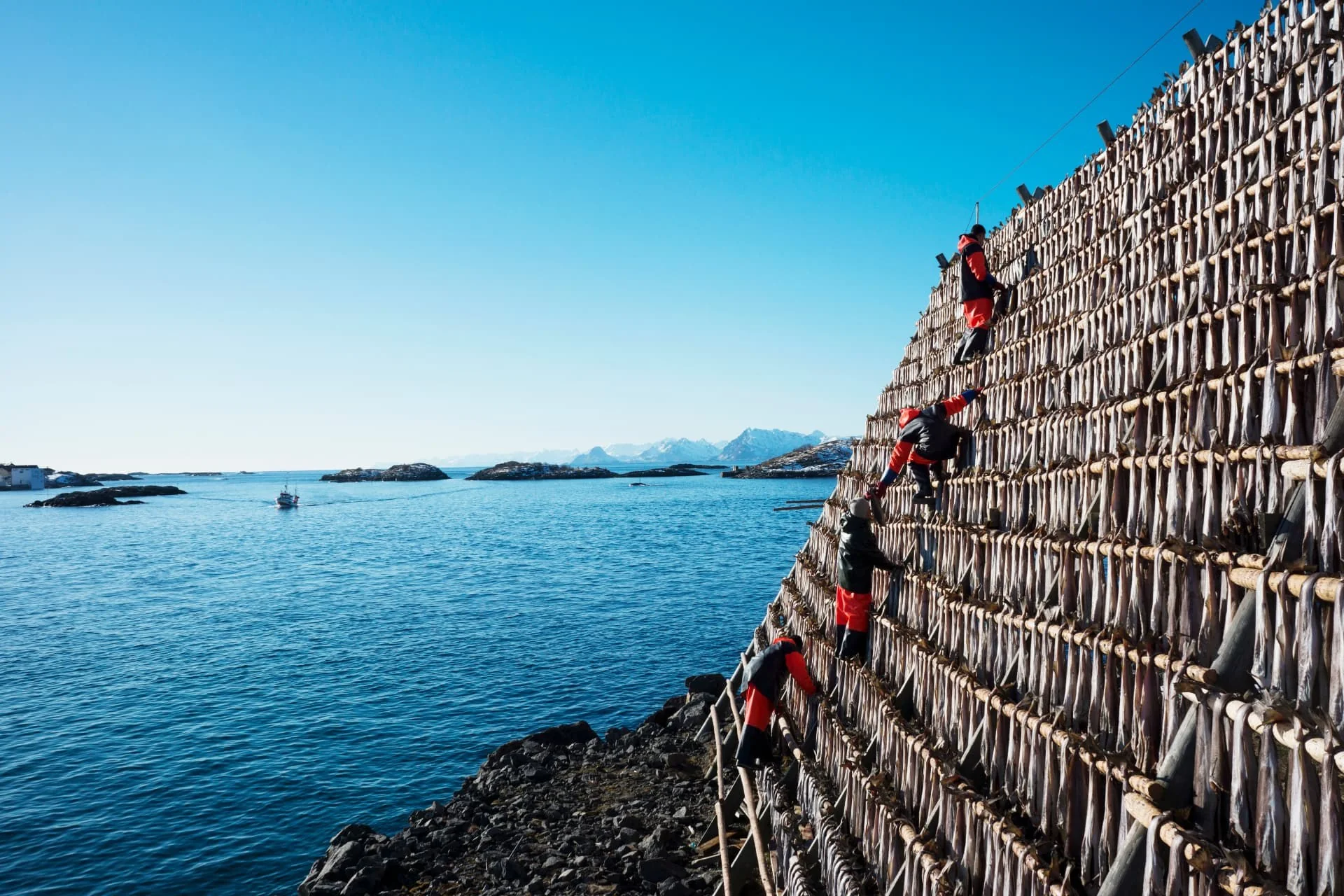
The official stockfish page distinguishes outdoor rack drying from finished-product supply: drying takes place from February to May, while stockfish is available all year. A delivery during the drying period may come from existing finished stock. The table does not assign a new-crop release date, because drying completion, subsequent assessment and the producer’s dispatch schedule need to be confirmed.
Stockfish is naturally dried outdoors. Artificially dried heads and cuts belong to a different product specification and should not inherit its rack-drying season. Buyers can ask for the crop year, species, finished grade and intended shipping week.
King crab: check the area and the annual rules
Norwegian management distinguishes the quota-regulated area in East Finnmark from fishing outside that area. The main divide is around 26°E near North Cape, but the legal boundary should be read from the applicable regulation. Fishing outside the quota area is managed to limit further spread; it is not unregulated. Gear, reporting and handling conditions still matter.
The government’s 2026 announcement and Directorate guidance describe an ordinary capture and storage closure from 1 March to 31 May inside the quota area, with specific exceptions. The table flags those months as an area-specific closure check, not “no product available”. Frozen inventory and legally sourced product from another permitted route cannot be assessed solely from a month name.
Outside those months, “quota/rules check” still does not mean unrestricted catch or guaranteed live supply. Quota decisions and amendments can change. A generic marketing season must never override the rules that apply to the actual vessel, catch area and shipment.
Brown crab: seasonal quality and order planning
Seafood from Norway describes brown crab as generally in season all year with the best quality in autumn.
The Institute of Marine Research describes biological changes and movement that help explain seasonal variation. Those observations are not a commercial delivery calendar. Live crab, whole cooked crab, picked meat and frozen products may follow different producer schedules. Agree the requested format, size and receiving date rather than assume that all brown-crab products share one availability window.
From calendar to a workable order
Confirm the final offer against the producer’s instructions and the destination requirements. The calendar does not establish import eligibility, remaining shelf life or transport time. Normar coordinates sourcing and direct delivery from Norwegian producers; the producer handles production and packing. The linked export-documentation guide provides a separate starting point for the shipment checks that accompany the commercial specification.
Further reading
- Seafood from Norway — Skrei
- Seafood from Norway — Cod
- Seafood from Norway — Stockfish
- Seafood from Norway — Salmon
- Seafood from Norway — Fjord trout
- Seafood from Norway — Brown crab
- Directorate of Fisheries — King crab (in Norwegian)
- Norwegian Government — King crab fishing in 2026 (in Norwegian)
- Institute of Marine Research — Brown crab (in Norwegian)